The easiest way to help communities with rubbish management
Sorting, Connecting and Recycling
UX/UI DESIGN . 3 WEEKS DESIGN SPRINT
3 - 25 March 2023
Recycler

QUICK SUMMARY
The recycler application is created for the Thai community. After I conducted extensive research and found that the main issue stems from a lack of waste management among members of the community. To address this, I developed a user-friendly - Recycler application. This application not only educates users on proper recycling techniques, but also enables easy connecting with local rubbish collectors, empowering individuals to take a more active role in waste reduction and management"

Getting started...
CHALLENGE
My challenge was design an application that helps communities resolve general problems. In my own community, the pervasive issue of waste mismanagement has led to health concerns, flooding, air pollution, and other negative consequences. Many people lack awareness about the importance of proper waste sorting and management. Based on extensive background check and user research, I have an idea that how might we create an application that would enable users to easily sort their waste and get connected with local rubbish collectors faster and easier. So that this app would motivate users to take an active role in improving our community's environment.
Role
This was an individual project generated from UX google certification and I was responsible for the entire design process solo.
Method
Competitive Audit, user journey mapping, storyboarding, wireframing, prototyping, usability testing
Approach
I started with waste management research in Songkhla, Thailand, then user research to generate personas, and small talk with other members to get more ideas on how they normally sort the rubbish. Then I group the pain points to identify the needs. I also did a competitive audit with direct competitors to get an insight into the gaps that I should address. The ideas of the product are based on user behaviors and make necessary processes as easy as possible. I then proceeded to prototype and test my ideas.
Understanding the problem...
BACKGROUND CHECK

Why?

These are 2 main problems based on the report
Lack of Recycling
The community still do not have adequate infrastructure
or resources to properly recycle waste materials.
Lack of Education
Lack of education about the importance of waste reduction and proper waste disposal practices, so it leads to a lack of awareness and accountability among individuals and communities.
USER RESEARCH
I conducted interviews and created personas to understand the users I’m designing for and their needs. A primary user group identified through research was a member of Hatyai, Songkhla community who lived in the community for more than a year and would like to help the community solve the waste problem.


Initially, I hadn't planned on this interview, but a casual conversation with friends about my recycling project led me to discover that many members of my community were selling their waste, including plastic, paper, and food waste, to a garbage collector. This unexpected revelation provided an opportunity for me to delve deeper into members' behavior and gain a better understanding of their waste management practices.
JOURNEY MAP
To gain a deeper understanding of the user's experience with rubbish management, I created a journey map that visualizes the typical steps involved in disposing of waste, including sorting, selecting a disposal method, connecting with a recycling company, and final disposal. Using this map, I asked participants to imagine a scenario where they had to sort and dispose of waste items such as fizzy cans, leftover food, and plastic wrap. This exercise helped me identify pain points and emotions associated with the user journey.


My research yielded valuable insights, revealing that waste management can be a challenging process for both beginners and experienced individuals, especially during the sorting phase. To improve efficiency, a user-friendly app that guides users through the entire process could prove beneficial. Additionally, I discovered that it is common practice for members of the community to sell their rubbish to local collectors
STORYBOARD

WHAT'S THE NEED?
The community members need…
A user-friendly app that can assist them in efficiently managing their waste.
This app should provide step-by-step guidance on the waste management process, starting from identifying the type of waste, sorting it accordingly, finding the best disposal method and even connecting with local rubbish collectors.
COMPETITIVE AUDIT
Before I move to the designing process, I believe it would be beneficial to conduct a competitive audit on existing recycling apps available in the market. This will allow me to gain valuable insights into the features and functionalities offered by these apps, identify any gaps or shortcomings that can be addressed, and determine best practices to incorporate into my own design. By taking this approach, I can ensure that my app meets user needs, stands out from the competition, and delivers an exceptional user experience.

Through the competitive analysis, I discovered that Green2Get and Recycle Day are the direct competitors in the waste sorting and recycling market in Thailand, and they are the only companies currently offering applications and websites for this purpose. My audit revealed a significant gap in the market for an app that provides guidance on waste sorting and bin selection, while also connecting users with recycling companies, offering secure in-app payment transfers, and scheduling rubbish bin pick-up times (run by the local council). Additionally, implementing a rewards system for users should not be a challenging task for a beginner. By addressing these gaps in the market, I aim to deliver an app that meets the needs of users, stands out from competitors, and contributes to the sustainable management of waste in Thailand
Starting the design
Crazy 8s
On the crazy eights exercise, I aimed to get as many ideas for my application based on the pain points that I found.

USER FLOW DIAGRAM
Once I identified user needs and generated ideas for the elements of my recycling application, I created a user flow diagram to ensure that the elements I design address user pain points and to visualize the flow of the application.

PAPER WIREFRAME
Drafting iterations of each screen on paper ensured that the digital wireframes incorporated elements that effectively addressed user pain points. To prioritize user needs, the home page was designed with the most essential functions and an intuitive search bar and sorting option to facilitate easy waste disposal. Additionally, the application features a news column and a 'PICK-UP' function that incentivizes new users to join the recycling community by offering the opportunity to sell recycled or other items to rubbish collectors.

USER FEEDBACK
These are 2 feedbacks that I received from my paper wirefeame.


DIGITAL WIREFRAMES
As the initial design phase continued, I made sure to base screen designs on feedback and findings from the user research.


USABILITY STUDIES
I conducted a usability study which provided valuable insights for refining the design from low fidelity to mock up and high fidelity. The research goals for this study are to identify the key challenges users face when using the Recycler app to complete core tasks, including finding information about waste disposal, creating listings for rubbish collectors, accepting an offer and transferring funds to their bank accounts.

REFINING THE DESIGN
4 out of 5 participants gave feedback that...
when they tapped on the Yellow bin, it directed them to the recycle waste page, but they couldn't find the relation between the two pages.

3 out of 5 participants gave feedback that...
The confirmation button was confusing because, upon tapping it, they were directed to another confirmation page instead of the end of the process.

4 out of 5 participants gave feedback that...
They would prefer to see the details of the offering instead of a listing of accepted offers and they also suggested adding
a hyperlink on the inbox and activity message to make it easier to navigate.

MAIN FEATURES

HIGH-FIDELITY PROTOTYPE
TRY ME


GOING FORWARD...
Impact
If the Recycler application is launched, the impact would be significant in several ways:
-
Environmental impact: The sorting option will encourage users to separate waste materials and dispose of them in the appropriate manner, reducing air pollution and keeping areas clean and tidy.
-
Efficiency for rubbish collectors: The app will make it easier for local rubbish collectors to find waste materials they are looking for, which will save them time and help them complete their work more efficiently.
-
Increased income for community members: The sorting option will allow community members to earn extra income by separating and selling recyclable materials. This will help them support themselves and their families while also helping the community to sort and recycle waste materials.
What I learned
To design a product that truly meets users' needs, it is essential to understand the target user and conduct thorough market research. Initially, I focused on recycling trends in Singapore and the UK, assuming that the wealth of information and existing applications in these markets would inform my ideation process. I later realized that user behavior in Thailand differed significantly from my assumptions, highlighting the importance of researching the right market. This discovery ultimately led me to design functions that better align with the specific needs and preferences of users in Thailand.
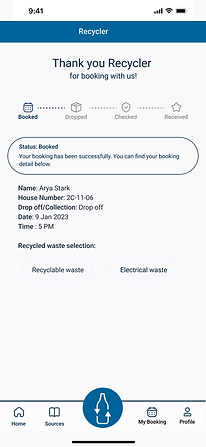
Drop off > Received point > cannot change to money.
collection > only able to check the public rubbish truck schedule > No point or money.
Previous version

Collection > Wait for the best offer > received money > transfer to personal account.
Drop off > Find the closest center on our app.
Current version
Next steps
Accessibility
I am looking to improve the overall user experience of my recycling application by both completing the Thai version and incorporating additional walkthrough functions. By doing so, I aim to cater to the needs of users who require more assistance and provide them with a better and more intuitive experience while using my application.
Usability Studies
Conduct another round of usability studies to validate whether the pain points users experienced have been effectively addressed.

Thank you for your time reviewing my work on the Recycler application!